PixInsight
I have further informed myself in the field of image processing. Apparently, PixInsight is the ultimate tool for astrophotography, but hard to use. Well, the whole thing is not easy. So I downloaded PixInsight and bought a book.
Yesterday I took with the camera 50 bias images at -15 degrees and 25 Darks at -15 degrees and different exposure times (5s, 10s, 20s, 30s, 60s) so I'm prepared for the next few nights. I should be able to reach this temperature even in the warmer nights.
I will then make the appropriate calibration images for colder temperatures.
Next up is generating Flats, so I have to try how it works. I tried it with a white T-shirt in front of the telescope and photographed the sky. However, the camera continues to expose itself while the data is being read out, and so the image upwards becomes brighter and therefore unusable as a flat.
Next time I will use Artemis Capture instead of Infinity software. There I can activate "Even Illumination" so that it should work.
So I worked for a first try without the calibration images. I had several error messages while doing the star alignment. By changing various parameters, I was able to reduce it and managed to stack a picture after a few attempts.
After that, I made a few small adjustments:
- Photometric Color Calibration
- histogram transformation
There are many other ways to manipulate the image to remove noise, to make details more visible, etc. But I still have a lot to learn and practice.
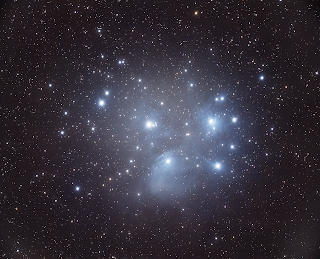
Here's a first try with the Whirlpool galaxy and only very simple editing.


You can see the difference very well. And that with very little editing. With calibration images and more editing, there would certainly be a much better result.
Yesterday I took with the camera 50 bias images at -15 degrees and 25 Darks at -15 degrees and different exposure times (5s, 10s, 20s, 30s, 60s) so I'm prepared for the next few nights. I should be able to reach this temperature even in the warmer nights.
I will then make the appropriate calibration images for colder temperatures.
Next up is generating Flats, so I have to try how it works. I tried it with a white T-shirt in front of the telescope and photographed the sky. However, the camera continues to expose itself while the data is being read out, and so the image upwards becomes brighter and therefore unusable as a flat.
Next time I will use Artemis Capture instead of Infinity software. There I can activate "Even Illumination" so that it should work.
So I worked for a first try without the calibration images. I had several error messages while doing the star alignment. By changing various parameters, I was able to reduce it and managed to stack a picture after a few attempts.
After that, I made a few small adjustments:
- Photometric Color Calibration
- histogram transformation
There are many other ways to manipulate the image to remove noise, to make details more visible, etc. But I still have a lot to learn and practice.
Here's a first try with the Whirlpool galaxy and only very simple editing.

Whirlpool-Galaxy: 6.5.2019
25 Images stacked with Atik Infinity SW

Whirlpool-Galaxy: 6.5.2019
The same 25 images stacked, color calibrated and histogram edited with PixInsight

Comments
Post a Comment